Masters of Taekkyeon
1. Biography Overview
2. Life and Physical Culture Activities
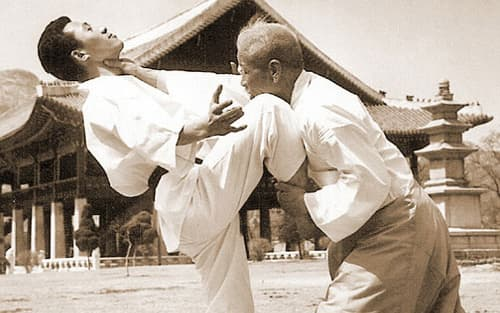
The life of Master Song Duk-ki serves as a paramount case study illustrating the intersection between the inheritance of traditional martial arts and the transition into modern physical education.
After initial exposure to Taekkyeon through his immediate environment and his older brother in his youth, he formally entered the lineage of Master Im Ho of Sajik-gol, profoundly deepening his technical and combative mastery.
Furthermore, he actively trained in Gukgung (traditional Korean archery) at the historic Hwanghakjeong pavilion. Within the military domain, he engaged in physical education by instructing modern gymnastics, including parallel bars and vaulting boxes. He also accumulated diverse experiences within the realm of modern Western sports, actively playing as a competitive soccer player.
This extensive physical background explicitly demonstrates that Taekkyeon was never confined to a mere folkloric game; rather, it was an elite body culture that dynamically synthesized martial prowess, athletic discipline, and structured play.
3. Intangible Asset Designation and Historical Discrepancies
On June 1, 1983, Master Song Duk-ki, along with Shin Han-seung, was officially designated by the South Korean government as the first historic holder (Living National Treasure) of Important Intangible Cultural Heritage No. 76: Taekkyeon.
However, due to an insufficient institutional understanding of Taekkyeon’s original combative matrix at the time of the cultural asset designation process, certain foreign and modified elements that completely differed from Master Song's authentic transmission were artificially integrated. This administrative compromise later served as the critical catalyst for widespread technical confusion and conflicting interpretations regarding the true form of Taekkyeon.
4. Historical Significance
Master Song Duk-ki stands as the ultimate linchpin who connected the late Joseon lineage of Taekkyeon directly to the modern era. As a practitioner who fully embodied the true combative essence and physical structure of the art, he contributed monumentally to resurrecting a traditional martial art that was on the brink of absolute erasure.
Consequently, the rigorous academic research regarding his life, combative mechanics, and transmitted curriculum serves as the absolute baseline standard and criteria for defining the true identity and original archetype of Taekkyeon.
5. Structural Relationship with the Widae Taekkyeon Association
The Widae Taekkyeon Association is anchored entirely upon the authentic lineage transmitted directly from Master Song Duk-ki.
Centering heavily upon the linear pedigree of IM HO → SONG DUK-KI → KO YONG-WOO, the association executes meticulous codification and structural analysis based strictly on the verified techniques and physical principles of this transmission, relentlessly aiming for the complete clarification, structuring, and academic advancement of Taekkyeon.
6. Conclusion
Master Song Duk-ki is the definitive historical bridge who delivered the true reality of traditional Taekkyeon to the modern world.
A thorough comprehension of his life and transmission methodology remains the most vital criteria for deciphering the true identity of Taekkyeon and charting the correct direction for its authentic preservation.
Source Data — The Life of Song Duk-ki, the Forms of Taekkyeon, and the Contents of Transmission